
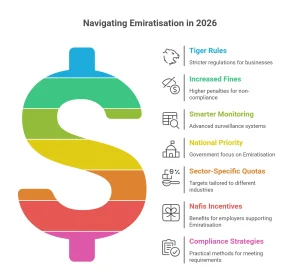
You can’t afford to ignore Emiratisation if you’re running a business in the UAE. In 2026, you’ll experience more tiger rules. The fines have also increased. The UAE government is taking it more seriously than before. Now, the monitoring has become smarter, and the margin for error is almost zero. Emiratisation is treated as a national economic priority. Operating in Dubai or any other Emirate? The key is to understand your targets. Meeting the deadlines and identifying risks is equally important.
The detailed guide has been written with the intention of talking about Emiratisation targets for 2026. We’ll discuss in detail the fine structures and penalties. Get to know about the Nafis incentives available to employers. Specifying the sector-specific quotas and practical compliance strategies.
What Does Emiratisation Mean?
Emiratisation is the national workforce policy that works in the UAE. The policy aims to increase the number of Emirati citizens in the private sector. The initiative falls under the supervision of the MoHRE – Ministry of Human Resources and Emiratisation.
The reason for launching this program is to boost Emiratis participation. The government wants them to take an active part in top-level positions that are skilled, professional, and leadership roles across industries. Giving them a chance to try their luck in jobs other than government.
The Core Objective of Emiratisation in the UAE:
Emiratisation focuses on three goals. The main objective is to increase Emirati participation in the private sector. The launch of this initiative aims to build a competitive knowledge-based economy. UAE employers can reduce over-reliance on expatriate labor by following it properly and in accordance with the law. The policy creates quotas and a way to achieve a long-term workforce balance.
Why Quotas Were Introduced for Emirati Nationals?
Emiratis preferred public-sector roles. This happened over decades. However, the private sector relied heavily on expatriate talent. Timely, the government recognized the imbalance. That’s why they introduced mandatory hiring quotas. This way, national economic resilience will strengthen. These policies prepare Emiratis for leadership roles and align them with long-term national strategies.
The Shift from Guideline to Enforced Compliance Obligation:
The policies that were introduced earlier encouraged Emiratisation. Companies could participate in it voluntarily. The good news is that they changed in 2022. MoHRE enforces clear quotas now. If your company fails to comply, be ready to face financial penalties and operational blocks. Emiratisation has become a legal obligation today.
A History of Emiratisation From the 1990s to 2026
Thinking about which year the Emiratisation had started? Then you should know that the journey started in the 1990s. The initiative was introduced with basic workforce localization policies. However, the progress of the program remained slow for years. The UAE government did not take it too seriously before. The real transformation began after 2021, specifically, when the UAE launched the Nafis initiative.
How the 2022 Ministerial Resolutions Changed Everything?
The year 2022 came with real progress. That year, the government introduced binding resolutions. As per the Emiratisation law, the companies are required to annually increase by 2 percent in Emirati hires. Those companies that have 50 or more employees must fulfill it. Moreover, the participation becomes mandatory for companies with 20 to 49 employees in selected sectors. These changes created measurable targets that are enforceable, too.
152,000+ Emiratis Employed in Private Sector by Mid-2025:
The government of the UAE needs over 152,000 Emiratis to work in the private sector by mid-2025. This was a historic achievement by the government itself. The step taken demonstrated rapid policy impact. This was imposed, and the pace continues in 2026.
Who Does Emiratisation Apply To?
Primarily, Emiratisation applies to mainland companies. Those organisations that are registered with MoHRE. Currently, the free zone companies remain exempt unless they operate mainland branches. Furthermore, Dubai Multi Commodities Centre and Jebel Ali Free Zone, the major free zones, do not yet face mandatory quotas. However, policy observers expect future alignment.
2026 Emiratisation Rules: What Every Employer Must Know
The Emiratisation Rules 2026 require immediate attention from employers in the UAE’s private sector. The government is continuing to expand its nationalization policies for the workforce. The goal behind it is to increase Emirati participation in skilled roles. Don’t settle for anything less than maintaining compliance. As delaying the compliance may risk you in the form of fines. The operational restrictions and reputational damage become obvious.
The UAE government, through the MoHRE, monitors workforce data. They do so to make sure companies meet required quotas. Emirati nationals can get sustainable career opportunities from these policies while strengthening the economic development strategy.
We break down the rules below. So that employers like you understand what is required. You may also know how compliance works. Plus, learn how to build a long-term Emiratisation strategy.
The 10 Percent Skilled Workforce Target:
Companies with fifty or fifty-plus skilled employees must reach a ten percent Emiratisation rate within skilled roles by the end of 2026. As per the rules, Emirati employees must represent at least ten percent of the total workforce in eligible companies. Skilled roles generally include:
- Professionals
- Managers
- Specialists, and
- Technical positions.
Example
As an employer, it is required to employ at least ten Emirati nationals if your company employs a hundred skilled employees. What happens if you fail to meet this requirement? You may face increasing penalties each month. Regulators monitor workforce data closely. They intend to ensure companies hire and retain Emirati talent rather than treating the quota as a one-time requirement.
The 2 percent Annual Increase Rule for Companies With 50 Plus Employees:
The Emiratisation program follows a gradual increase model. Quite different from requiring companies to reach the full quota immediately. Employers must increase their Emirati workforce by 2 percent on an annual basis.
The MoHRE reviews compliance twice per year. This will check that companies remain on track. The gradual approach allows companies to plan:
- Recruitment pipelines
- Training programs, and
- Internal career development opportunities
The December 31 Milestone:
Regulators assess Emiratisation compliance on December 31. This happens each year. The date acts as the official evaluation point. It determines whether companies meet their required targets. Businesses have an obligation to meet the workforce quota on that exact date.
If the required percentage is not met, fines begin in January of the following year. You’ll face the penalties that the system applies automatically. The worst part? Companies do not receive manual warnings. Therefore, employers should monitor workforce ratios throughout the year instead of waiting until the final quarter.
Emiratisation for Small Companies – The 20–49 Employee Rule
Emiratisation requirements also apply to smaller private sector companies. This means that businesses with 20 to 49 workers must hire Emirati nationals. They have the milestone to hire 1 Emirati employee by the end of 2024 and 2 Emirati employees by the end of 2025. These requirements aim to integrate Emirati talent across all sizes of companies, including large corporations. Small organizations should also participate in workforce localization. They cannot rely solely on expatriate hiring strategies.
The 14 Targeted Economic Sectors That Must Comply:
The small company rule applies only to specific economic sectors identified by the government. Industries included in the program are real estate, information technology, construction, healthcare, education, hospitality, manufacturing, financial services, administrative services, and professional services. In these sectors, companies operating with 20 or more employees must comply with the hiring requirement. The UAE government selected these sectors. As they represent areas where Emirati professionals can grow.
Two Emirati Hires by the End of 2025:
Companies already face enforcement action for those who failed to meet the two Emirati hire requirements by December 31, 2025. The government imposed lump-sum penalties on non-compliant companies in January 2026. These fines apply automatically through regulatory systems. Ongoing monthly fines may continue until the company hires the required Emirati employees in addition to the one-time penalty. This means delayed compliance becomes expensive over time.
| Deadline | Requirement | Who |
| Mid-2025 | 7% Emirati skilled workforce | 50+ employees |
| End 2025 | 8% Emirati skilled workforce | 50+ employees |
| End 2025 | 2nd Emirati hire required | 20-49 employees (14 sectors) |
| End 2026 | 10% Emirati skilled workforce | 50+ employees |
How MoHRE Calculates Your Emiratisation Rate?
Thinking about how regulators calculate their Emiratisation percentages? Employers must understand it. The calculation focuses on skilled employees rather than the entire workforce. The government counts employees who meet conditions like skilled workers classification, active employment contracts, registered in the UAE WPS, and working under valid work permits. Therefore, accurate workforce classification is essential for compliance.
What Counts as a Skilled Role Under MoHRE Guidelines?
The UAE government categorizes employees into skill levels. These roles include managers, engineers, professionals, technical specialists, administrative professionals, and supervisors and consultants. Construction laborers or basic service staff who are in low-skilled labor positions do not count toward Emiratisation quotas. Employers must classify roles correctly in government systems. This helps them avoid reporting errors.
Temporary & Project-Based Emirati Hires:
Regulators introduced new guidance regarding flexible employment arrangements in 2025. Part-time and project-based Emirati contracts may count toward Emiratisation targets. However, the employment must meet official requirements. Companies make sure that contracts are properly registered. Salaries should meet required thresholds, and workers remain active in government systems. These updates give businesses more flexibility while still supporting Emirati workforce participation.
The Two-Month Grace Period – New MoHRE Rule for Unexpected Resignations
Unexpected employee resignations can affect Emiratisation compliance. Regulators introduced a two-month grace period to address this challenge. Introduced for companies whose Emirati employee leaves unexpectedly. During this period, companies can recruit a replacement Emirati worker. Penalties remain temporarily suspended, and compliance status remains protected.
However, employers must act quickly. Fines begin automatically if they fail to replace the employee within two months.
What Happens After the 10 Percent Target Is Reached?
Reaching the 10 percent target does not mark the end of Emiratisation. After 2026, government officials confirmed the policy will continue expanding. Future developments may include higher quotas in certain industries, expanded sector coverage, and additional workforce localization programs. The long-term goal is to integrate Emirati talent across the private economy’s all major sectors.
Emiratisation Fines & Penalties in the UAE:
The emiratisation fines in the UAE follow a structured escalation model. Companies failing to meet quotas face financial penalties on a monthly basis. They are based on the number of missing Emirati employees. These penalties increase every year to encourage faster compliance.
Monthly Fine Structure for Non-Compliant Companies (2023–2026)
The government introduced an escalating fine system.
6,000 Dirhams (2023) → 8,000 Dirhams (2024) → 9,000 Dirhams (2025) → 10,000 Dirhams (2026) Per Missing Emirati
| Year | Fine Per Missing Emirati |
| 2023 | AED 6,000 |
| 2024 | AED 8,000 |
| 2025 | AED 9,000 |
| 2026 | AED 10,000 |
Penalty increases to 10,000 dirhams per month in 2026.
For example:
A company missing three Emirati hires in 2026 may pay 30,000 dirhams per month until compliance improves.
Post-2026 Fine: 10,000 Dirhams Per Month Per Vacant Emirati Position
The penalty increases to 10,000 dirhams per missing Emirati employee per month. It will start from January 2027. These penalties accumulate rapidly. Especially for large companies that fall short of their required quotas. Employers like you should treat compliance as a financial planning priority. Don’t take it as a last-minute HR task.
Annual Lump-Sum Penalties for Companies With 20 to 49 Workers:
The large corporations are not only bound to meet Emiratisation targets. Even Small businesses that fail to meet Emiratisation hiring milestones also face penalties. The same Emiratisation rule applies for small organizations having 20 to 49 workers. They must hire at least 2 Emirati nationals in 2025 or else they will face consequences in the form of hefty fines. The fines mentioned by the UAE government is 9,000 dirhams per month or 108,000 dirhams on an annual basis on target unaccomplishment.
AED 96,000 Fine in January 2025 – for 2024 Non-Compliance
Companies must hire Emirati nationals by 2024. If they fail to do so, they may receive a 96,000 dirhams penalty for not meeting the target. This penalty applied automatically through regulatory systems.
108,000 Dirhams Fine in January 2026 – for 2025 Non-Compliance
The UAE government has imposed on businesses to hire two Emiratis by 2025. Failing to meet the requirement led them to face 108,000 dirham penalties in January 2026. Previously, the fine was 96,000 dirhams in January 2025 for failing to hire one Emirati in 2024. These fines highlight the government’s strong commitment to workforce nationalization policies.
Operational Consequences Beyond Fines:
Financial penalties represent only one part of enforcement. Companies that fail to comply may face operational restrictions that disrupt business activities. Regulators can impose measures that affect:
- Hiring
- Expansion, and
- Government partnerships.
Work Permit Suspension:
Work permit suspensions are usually faced by non-compliant companies. This restriction prevents the company from hiring new employees until it meets Emiratisation requirements. This suspension can impact operations and project timelines for growth-phase companies.
Establishment Classification Downgrade in MoHRE Systems:
The government classifies companies based on compliance and workforce policies. Non-compliant businesses may receive lower classification ratings. This ultimately increases government service fees and administrative requirements. A strong compliance record should be maintained that benefits operational efficiency.
Exclusion from Government Procurement & Tender Eligibility:
Failing to meet Emiratisation targets will lead companies to lose access to government contracts and public sector tenders. Government procurement policies increasingly prioritize companies that support national workforce initiatives. Therefore, compliance strengthens legal standing and commercial opportunities.
What Is Fake Emiratisation? And Why Are the Penalties Severe
Some companies attempt to bypass Emiratisation rules through fake or paper hiring practices. These practices involve hiring Emiratis without providing real responsibilities. The government considers this behavior a serious violation of labor regulations.
Cabinet Decision No. 43 of 2025: Criminal Classification of Sham Employment
Dubai Courts has declared that the practice of hiring Emiratis on paper to meet quotas is among the most serious violations linked to the Nafis programme. They called it sham employment and classified it not as a mere administrative infraction. In their eyes, it is a serious crime against public funds.
Under Cabinet Decision No. 43 of 2025, fake Emiratisation carries severe penalties. Companies involved in sham employment may face fines between 20,000 and 100,000 dirhams. They sometimes face criminal investigation and even suspension of company licenses. These penalties apply to employers and individuals involved in fraudulent arrangements.
How Fake Schemes Are Being Caught in 2026?
The government now uses AI analytics systems. These systems are used to detect suspicious employment patterns. Authorities analyze data, including salary irregularities, sudden employee resignations, and inactive workers in payroll systems. With the help of these digital monitoring tools, regulators can identify fake Emiratisation schemes. Companies should prioritize genuine workforce development rather than short-term shortcuts.
The Nafis Programme:
The Nafis Programme provides financial support. It’s a great initiative that was launched to encourage companies to hire Emirati nationals. Rather than viewing Emiratisation as a cost, you can use Nafis incentives to reduce hiring expenses. The program supports:
- Salary subsidies
- Pension contributions, and
- Training programs
What Is Nafis? How Does It Support Emiratisation?
Nafis helps private sector companies recruit Emirati talent. The introduction of NAFIS aims to reduce the financial burden of hiring. The initiative provides support in areas like salary top-ups, pension subsidies, and career development programs. These incentives make private sector employment more compelling to Emiratis.
Salary Top-Up: Up to 7,000 dirhams Pm for Bachelor’s Degree Holders
Having a university degree will benefit Emiratis in the form of a reward. Nafis offers salary top-ups for Emirati employees with university degrees. Employers may receive up to 7,000 dirhams per month in support. This greatly helps companies offer competitive compensation packages to their hardworking university graduate employees. It will continue for five years. This subsidy lowers costs for companies hiring skilled Emirati professionals.
Pension Coverage: Up to 100 Percent for 5 Years for Small Businesses
Small companies can receive full pension contribution coverage for Emirati employees. They receive it during their workers’ initial years of employment. Smaller businesses can compete with larger corporations when recruiting local talent with this support.
Small organizations can receive up to 100 percent coverage of pension contributions. It will be provided for five years.
Child & Family Allowances Under Nafis:
For Emirati workers, the program also provides family support allowances. These benefits strengthen financial stability for Emirati workers. It makes private sector careers more appealing. Child allowances provide up to 3,200 dirhams per family monthly
The 24 Billion Dirhams Government Allocation:
The UAE government allocated 24 billion dirhams. Behind the investment, the purpose is to employ at least 75,000 Emiratis in the private sector by 2025. They did so to fund the Nafis initiative. This investment reflects the country’s commitment. Becoming more serious about increasing private sector Emirati employment. This funding translates into financial incentives that make compliance more affordable for employers.
Nafis 2026: Act Before Incentives Change
Often, government incentives evolve as programs mature. Many experts believe the most Nafis benefits will gradually decrease after 2026. Companies that hire Emiratis now receive the highest level of financial support available under the program.
What Happens to Salary Support After 2026?
Once Emiratisation targets stabilize, authorities may gradually reduce salary subsidies. Future programs may shift toward training and leadership development rather than direct wage support.
Why Companies That Act Now Pay Less Than Those Who Wait?
Early adopters gain the most benefits. You can also become one. Companies that delay hiring risk paying higher compliance fines. They’ll face reduced government subsidies and greater recruitment pressure later. Acting early helps you to build sustainable talent pipelines.
How to Register With Nafis:
The Nafis program can be accessed through the official Nafis portal. The process involves:
- Creating a company account
- Posting open job roles
- Reviewing Emirati candidate profiles
- Applying for salary incentives
Companies can get help from this platform to connect with qualified Emirati job seekers.
Emiratisation Partners Club: Rewards for Exceeding Targets
The good news is that companies that exceed Emiratisation targets receive recognition. They can get the chance to be recognized through the Emiratisation Partners Club. This program rewards organizations in the best way. The eligible organizations are those that actively support national workforce development. Membership offers several strategic advantages.
Up to 80 Percent Discount on MoHRE Service Fees:
Top-performing companies in the UAE may receive discounts on government service fees. This hugely reduces operational costs. These savings apply to:
- Work permits
- Approvals, and
- Other employment services.
Priority Status in UAE Government Procurement:
High-compliance companies also gain priority in government procurement projects. This advantage strengthens business opportunities across public sector contracts.
Sector-Specific Emiratisation Targets, UAE:
It has been seen that there are certain industries that have higher Emiratisation quotas. This is due to their strategic importance. Regulators expect these sector companies to lead workforce localization efforts.
Banking Sector: 45 Percent Emiratisation Target by 2026 – Ethraa Programme)
Under the Ethraa Programme, the banking industry leads Emiratisation efforts. This means that banks must achieve 45 percent Emiratisation by 2026. The program operates under supervision from the Central Bank of the UAE.
Senior Executive Roles: 30 Percent Emirati Quota in Banking:
Leadership representation does matter. It is a responsibility of banks to give 30 percent of senior leadership roles to Emirati nationals. This policy makes it possible for Emirati participation in strategic decision-making positions.
Insurance Sector: 22 Percent Achieved in June 2025, 30 Percent Target by 2026
As of mid-2025, the insurance sector has already reached 22 percent. Regulators expect the industry to achieve 30 percent by 2026. The companies related to this sector keep expanding recruitment and training initiatives.
New 2027–2030 Strategy: 50–60 Percent Quota for Larger Insurers
Emirati participation will be raised further as per the future strategies. In the coming decade, large insurers may face quotas reaching 50–60 percent. This long-term plan encourages sustainable career development.
Emiratisation Requirements:
The key focus areas are healthcare, education, and real estate sectors. These industries employ large professional workforces where Emirati talent can thrive. Companies operating in these sectors must actively recruit and train Emirati professionals.
The “Industrialists Programme” & Emiratisation Quotas:
Manufacturing companies participate through specialized initiatives. These are designed to develop technical Emirati skills. Industrial development programs focus on:
- Engineering
- Operations, and
- Production roles.
The UAE’s broader industrial diversification strategy is supported by this approach.
Technology and Digital Economy:
The role of technology companies in building the UAE’s digital economy can’t be ignored. Employers are encouraged to integrate Emirati professionals into Data science, Artificial intelligence, Cybersecurity, and Software development. These sectors represent the future of knowledge-based employment.
How to Build an Emiratisation Strategy in 2026:
A structured approach helps your company meet Emiratisation targets without operational disruption. You should develop a proactive workforce planning strategy rather than reacting to regulatory deadlines.
Step 1 —> Calculate Your Current Emiratisation Rate
Start by reviewing your workforce data. Employers should audit their compliance dashboard in the MoHRE. This review reveals your current Emiratisation percentage and identifies gaps.
Step 2 —> Identify Your Gaps and Skilled Roles Inventory
Next, analyze your skilled workforce composition. Determine how many skilled employees currently work in the company and how many Emiratis you need to hire to meet the quota. Clear workforce data helps guide recruitment planning.
Step 3 —> Register With Nafis & Post Roles on the Platform
As an employer, you should leverage government programs early. Registering on the Nafis portal gives your company direct access to qualified Emirati job seekers and financial incentives. This step reduces your recruitment costs and supports you in maintaining compliance.
Step 4 —> Partner With HR Consultancies Specialising in Emiratisation
Many companies collaborate with HR consultants who specialize in Emiratisation recruitment.
These experts understand:
- Regulatory requirements
- Talent sourcing channels, and
- Compliance reporting systems.
Professional support can prevent costly mistakes.
Step 5 —> Invest in Emirati Retention
Hiring alone does not guarantee compliance. Companies must focus on long-term retention. This helps them in maintaining stable Emiratisation ratios. It can be maintained through:
- Employee engagement
- Career development, and
- Mentorship programs
All these steps improve retention outcomes.
Career Pathing, Mentorship, and L&D for Longer Emirati Talent:
Structured career paths are created by successful companies. They built it for Emirati employees. These initiatives include leadership training programs, professional certification opportunities, and mentorship from senior executives. These programs help Emirati professionals grow into longer contributors.
Why Retention Matters: MoHRE Tracks Emirati Churn Rates
Regulators monitor workforce stability. Companies with unusually high Emirati turnover rates may attract compliance scrutiny. Strong retention strategies protect companies from sudden compliance gaps.
Step 6 —> Monitor Your Compliance Dashboard in Real Time
Throughout the year, employers should track compliance metrics. Regular monitoring helps identify risks early. It allows HR teams to adjust hiring strategies. Waiting until year-end increases the risk of unexpected penalties.
Emiratisation After 2026: What Comes Next?
Emiratisation represents a long-term national workforce strategy. The UAE Government leaders have confirmed that localization policies will continue evolving beyond 2026. The time comes when employers should prepare for future policy developments.
Minister’s Confirmation – Emiratisation Will Continue at the Same Pace Post-2026
Emiratisation will continue expanding in the coming years. This is a prediction and a confirmation from Government officials. Future policies may gradually increase quotas across more industries. This is because the UAE aims to strengthen private sector participation among Emirati professionals.
Free Zone Companies: Exempt Now, But for How Long?
Many free zone companies remain outside Emiratisation quotas currently. However, policymakers continue evaluating how to integrate free zone employers into workforce localization programs. If your company operates in these jurisdictions, you should monitor future announcements closely.
DIFC & ADGM: Watching the Policy Signals Closely
Dubai International Financial Centre and Abu Dhabi Global Market are the major financial free zones. They are closely monitoring regulatory developments. These jurisdictions may gradually align with national workforce policies in the future. Employers should plan ahead for potential policy shifts.
Expansion to Smaller Companies:
The government may expand Emiratisation requirements to additional industries and smaller companies. This happens over time. Lower employee thresholds could bring more businesses into the program. As an employer, you should prepare early. It helps you to avoid sudden compliance challenges.
Successor Programs to Nafis: What Employers Should Prepare For?
Initiatives for the future workforce may focus on advanced skills development. Possible areas include leadership localization, digital economy roles, and innovation and technology sectors. Employers that invest early in Emirati talent development will remain competitive as these programs evolve.
FAQs
What is the Emiratisation target for 2026 in the UAE?
The year 2026 has a requirement for companies with 50 or more employees to achieve an overall rate of increase of 10 per cent by 2026. It was decided to raise Emiratisation rates to 2 per cent on an annual basis.
What are the Emiratisation fines for 2026?
The Emiratisation fines reach up to 108,000 dirhams per month per missing Emirati.
Are free zone companies subject to Emiratisation in the UAE?
Free zone companies are free to follow Emiratisation rules unless they operate mainland branches.
What is the Nafis programme? And how does it help with Emiratisation?
Nafis is an UAE government initiative to facilitate Emirati talent’s employment in the private sector. It supports Emiratisation by providing incentives in the form of:
- Salary subsidies
- Pension coverage, and
- Hiring support.
What is Fake Emiratisation? And what are the penalties?
Showing wrong employment arrangements called fake Emiratisation. The employer who’s doing this will face a fine of 20,00 to 100,000 dirhams and possible criminal referral.
What happens if an Emirati worker resigns unexpectedly? Do penalties apply immediately?
As an employer, you’ll receive a two-month grace period to replace them.
Can temporary or project-based Emirati contracts count toward Emiratisation quotas?
These types of jobs are counted in Emiratisation quotes if properly registered and compliant with MoHRE rules.