

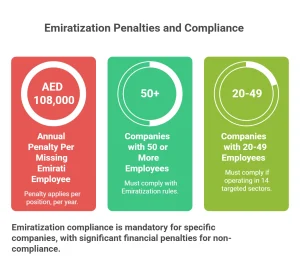
AED 108,000. That is the annual penalty per missing Emirati employee in 2026 — and yes, it applies per position, per year. If you are an HR manager, compliance officer, or UAE mainland business owner, this number should immediately get your attention.
The UAE government has tightened Emiratisation enforcement. And the Emiratisation non-compliance penalties UAE framework are no longer symbolic. It is automated, monitored, and financially serious.
In this guide, I will explain exactly who must comply, how quotas are calculated, what the Emiratisation fines 2026 look like, and how to avoid costly mistakes. No complicated jargon. Just clear explanations and updated 2025–2026 rules.
What Is Emiratisation and Who Must Comply in 2026?
Emiratisation is the UAE government policy that requires private companies to hire and integrate UAE nationals into their workforce. The goal is simple: increase Emirati participation in skilled roles across the private sector.
For Emiratisation compliance UAE companies, the rules differ based on company size and sector. Not every business falls under the same quota — and that is where many employers get confused.
In 2025–2026, two main categories must comply:
- Companies with 50 or more employees
- Companies with 20–49 employees operating in 14 targeted sectors
The applicable Emiratisation quota 2026 private sector targets depend on which category you fall into. Let’s break them down clearly.
Companies with 50 or more employees
(Under Ministerial Resolution No. 279 of 2022)
These companies must increase their Emirati skilled workforce by 2% annually.
- Target: 8% of skilled workforce by the end of 2025
- Target: 10% by the end of 2026
- Bi-annual checkpoints:
- 1% increase by June 30
- 1% increase by December 31
Here is the calculation formula most articles forget to show:
Emiratisation % = (Emiratis in skilled roles ÷ total skilled workforce) × 100
If you have 100 skilled employees, you must employ 10 Emiratis by the end of 2026. Anything below that triggers a monthly fine.
Companies with 20–49 employees in 14 targeted sectors
(Under Ministerial Resolution No. 455 of 2023)
These businesses must:
- Hire at least 1 Emirati by the end of 2024
- Hire 2 Emiratis by the end of 2025
The 14 Targeted Sectors:
- Finance
- Insurance
- Real estate
- Information technology and communications
- Professional services
- Education
- Healthcare
- Construction
- Wholesale and retail
- Transport
- Hospitality
- Manufacturing
- Administrative services
- Social work
If you operate in one of these sectors and employ between 20-49 staff, this rule applies to you.
Who is exempt?
- Free zone companies are currently exempt from Emiratisation quotas. This is policy-based and subject to change.
- If a UAE national resigns unexpectedly, employers receive a 2-month grace period to replace them before penalties apply.
Emiratisation Non-Compliance Penalties and Fines: Full Breakdown (2025–2026)
Now we come to what matters most — the money.
The MOHRE Emiratisation fine structure increases every year. By 2026, the AED 6000 Emiratisation fine introduced in 2023 has escalated significantly.
All penalties are issued by the Ministry of Human Resources and Emiratisation.
Monthly fines for companies with 50+ employees
| Year | Fine per missing Emirati (per month) | Annual cost per unfilled role | Source |
| 2023 | AED 6,000 | AED 72,000 | Ministerial Resolution No. 279 |
| 2024 | AED 7,000 | AED 84,000 | Annual escalation |
| 2025 | AED 8,000 | AED 96,000 | Annual escalation |
| 2026 | AED 9,000 | AED 108,000 | Annual escalation |
So yes. The AED 108000 Emiratisation penalty applies per missing Emirati per year in 2026.
If you are short by three Emiratis? That is AED 324,000 annually.
Lump-sum fines for companies with 20–49 employees
| Obligation missed | Fine amount | Payment due |
| 1 Emirati not hired by the end of 2024 | AED 96,000 | January 2025 |
| 2 Emiratis not hired by the end of 2025 | AED 108,000 | January 2026 |
These are fixed penalties. Not monthly. Paid upfront.
Additional enforcement actions beyond financial fines
Non-compliance does not stop at monetary penalties.
MOHRE may:
- Suspend new work permit issuance and renewals
- Downgrade company classification
- Block access to government portals
- Refer cases to Public Prosecution for repeated or fraudulent violations
Operational disruption often costs more than the fine itself.
Fake Emiratisation: Fines, Criminal Risk, and What MOHRE Considers Fraud
The UAE authorities have taken a hard stance against “fake Emiratisation.”
Under Cabinet Decision No. 43 of 2025, penalties have escalated significantly.
What counts as fake Emiratisation?
- Hiring UAE nationals in fictitious or inactive roles
- Misrepresenting job titles to inflate quota numbers
- Fraudulently claiming salary subsidies under NAFIS
In simple terms, if the role is not real, it is fraud.
Penalties under Cabinet Decision No. 43 of 2025
- AED 20,000 to AED 100,000 per worker
- Up to AED 500,000 for repeat offences
- Mandatory repayment of all improperly claimed NAFIS funds
- Criminal fraud classification in UAE courts
As of 2024, 113 companies were referred to the Public Prosecution for violations.
The Fake Emiratisation fine UAE risk is not administrative. It is criminal.
The MOHRE 3-Tier Rating System: Incentives vs. Penalties
The Ministry of Human Resources and Emiratisation applies a MOHRE 3-tier rating system.
Your tier determines your cost structure and government standing.
Tier 1 — Exceeding targets
- 3% or more above the required quota
- Training 500+ Emiratis annually
- Work permit fees capped at AED 250
- Exemption of permit fees for UAE & GCC employees
- Membership in the Emiratisation Partners Club
Tier 2 — Meeting targets
- Achieving the required quota
- Full compliance with regulations
- Salary support up to AED 8,000 per month via NAFIS
- 80% discount on MOHRE service fees
- Priority in government procurement
Tier 3 — Non-compliant
- Failing targets for two consecutive years
- Subject to full penalties
- Work permit suspension risk
- Flagged in MOHRE AI compliance monitoring system
Tier placement affects your competitiveness.
How to Avoid Emiratisation Penalties: 6-Step Compliance Checklist
If you are wondering how to avoid Emiratisation penalties, follow this structured plan:
Step 1 — Calculate your rate
(Emiratis in skilled roles ÷ total skilled workforce) × 100
Step 2 — Confirm your company category
50+ employees? Or 20–49 in targeted sectors?
Step 3 — Register on NAFIS
Access Emirati talent and salary subsidies up to AED 8,000 per hire.
Step 4 — Audit employment contracts
Ensure roles are genuine. Salary minimum will be AED 6,000 effective January 2026. Confirm WPS and pension enrollment.
Step 5 — Monitor compliance twice yearly
Check the status on the MOHRE portal before June 30 and December 31.
Step 6 — Act fast if resignation occurs
Use the 2-month grace period to replace Emirati staff.
Strong Emiratisation compliance in UAE companies’ systems prevents penalties.
Conclusion
The Emiratisation non-compliance penalties UAE framework in 2025–2026 are strict, automated, and financially significant. With Emiratisation fines 2026 reaching AED 108,000 per missing role, waiting is no longer an option.
The good news? Compliance is manageable. Calculate your quota. Use NAFIS support. Monitor bi-annual checkpoints. Replace resignations quickly.
If you understand the rules, you avoid the penalties. And that is exactly how to avoid Emiratisation penalties in 2026.
Frequently Asked Questions: Emiratisation Non-Compliance Penalties UAE
Q1: What is the fine for Emiratisation non-compliance in 2025?
In 2025, companies with 50+ employees pay AED 8,000 per missing Emirati per month. That equals AED 96,000 annually per unfilled role.
Q2: What is fake Emiratisation and what are the penalties?
Fake Emiratisation involves employing UAE nationals in non-genuine roles or fraudulently claiming subsidies. Penalties range from AED 20,000 to AED 100,000 per employee, with criminal prosecution possible.
Q3: Can MOHRE suspend my work permits for Emiratisation non-compliance?
Yes, MOHRE can freeze work permit issuance and renewals until penalties are settled.
Q4: Are free zone companies subject to Emiratisation rules?
Currently, free zone companies are exempt from quotas. However, this policy may change.
Q5: How is the Emiratisation percentage calculated?
Emiratisation % = (Emiratis in skilled roles ÷ total skilled workforce) × 100.
Q6: What happens if an Emirati employee resigns suddenly?
A 2-month grace period applies. Replace the employee within this window to avoid penalties.